Drywall Contractors in Allouez, WI — Residential & Commercial Drywall Specialists
Repair, plaster blending, texture matching and remodel drywall across Allouez, where three separate residential historic districts cover houses built between 1910 and 1989.
Green Bay Elite Drywall is your local resource for drywall work throughout Allouez, WI. We work with experienced drywall professionals who hang, tape and finish board in Northeast Wisconsin homes and commercial spaces every week.
Allouez is wedged between Green Bay to the north, De Pere to the south, the Fox River to the west and the East River to the east. There is nowhere left to expand into, which settles what the drywall work here is: repair, remodel and finish work on houses that already exist, rather than boarding out new framing. Three of the village's National Register listings are residential districts, and between them they span 1910 to 1989 — most of the twentieth century, in one small village.
That range is the whole story for anyone quoting work here. A house from 1910 is plaster over wood lath. A house from 1935 might be either. A house from 1959 is board with a sprayed ceiling. They need different compound, different technique and different expectations about how invisible the finished repair will be, and the only reliable way to know which one you have is to look at a cut edge rather than guess from the street.
Drywall Services Available in Allouez, WI
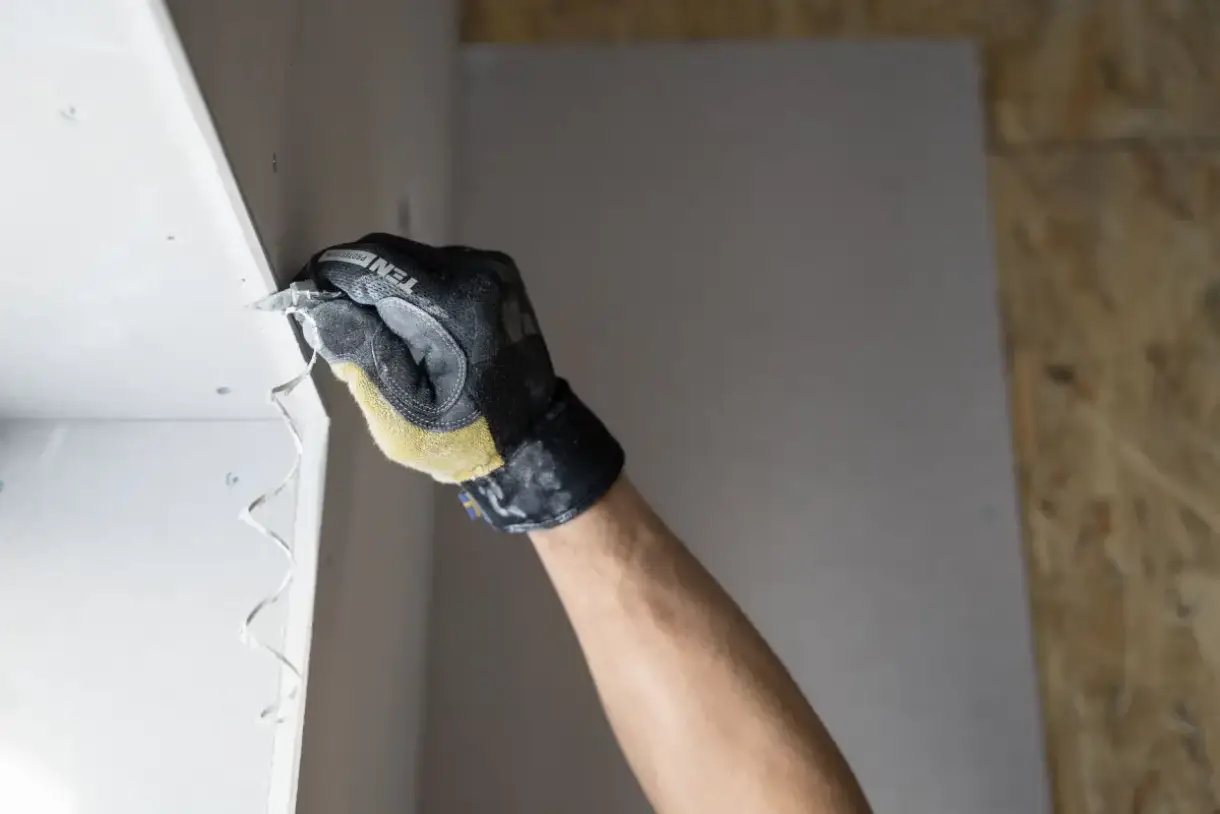
Plaster repair, ceiling repair and texture matching carry most of the residential work in Allouez, which is what a fully built-out village of century-old neighborhoods produces. Drywall replacement comes up where an older wall has been patched past the point of patching again. Installation work is almost entirely basements, additions and remodels rather than new houses, because there is no land left to build them on.
Residential Drywall
Drywall Installation Process for Allouez Properties
- 1
Walk the Framing and the Conditions
The estimate comes from the space rather than a phone description, and in this climate it comes from the conditions as well. Framing gets checked for plane, because a stud bowed a quarter inch will telegraph through finished board and no compound fixes it afterward. Fastener backing gets confirmed where fixtures and cabinets will mount later. Panel type is decided room by room. And the heat situation gets established honestly — whether the building will be at a workable temperature through the finishing phase, because that determines the schedule more than the crew size does. In Allouez this step is largely about identifying the wall system, since the village's residential districts span 1910 to 1989 and plaster and board can sit a block apart.
- 2
Hang the Board
Ceilings first, then walls, so wall panels support the ceiling edge and the corner closes tight. Panels run perpendicular to framing where the layout allows, which puts each sheet across more members and spreads any movement. Seams stagger so no two joints stack, and joints stay away from door and window corners where stress concentrates. Screws go in at the assembly's spacing, set below the paper without tearing it. On ceilings the panel thickness follows the framing spacing rather than the price list, because 1/2 inch board on 24-inch centers develops a visible sag long before anything else on the job fails.
- 3
Tape and Coat at a Pace the Building Allows
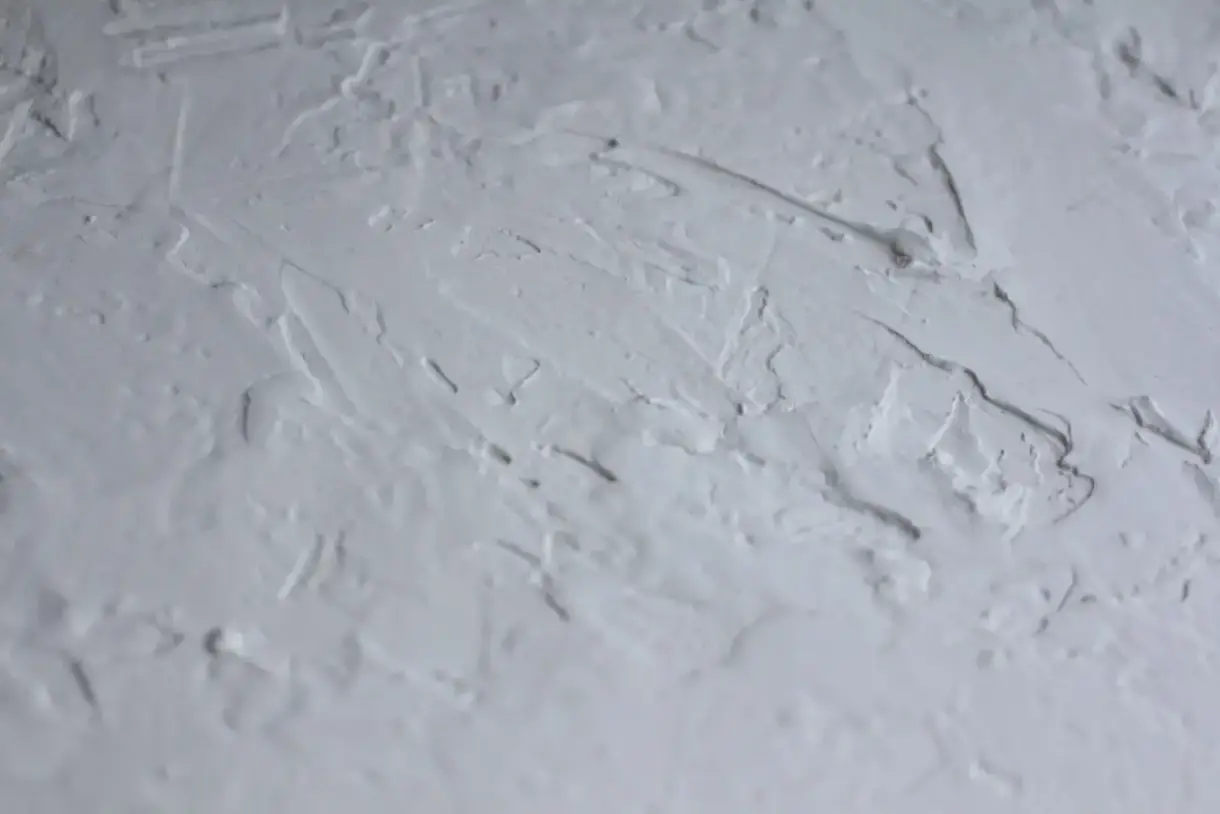
Tape is embedded in a wet bed coat at every seam and inside corner, corner bead is set and checked for straightness, then fill and finish coats go on, each feathered wider than the last. Every coat dries completely before the next — this is the fixed constraint and adding people does not shorten it. In a cold or unheated building it lengthens considerably, which is where setting-type compound earns its place: it cures chemically rather than by evaporation and can be recoated sooner. What it cannot do is replace drying on the final coats that get sanded and seen.
- 4
Sand, Match, and Hand Over
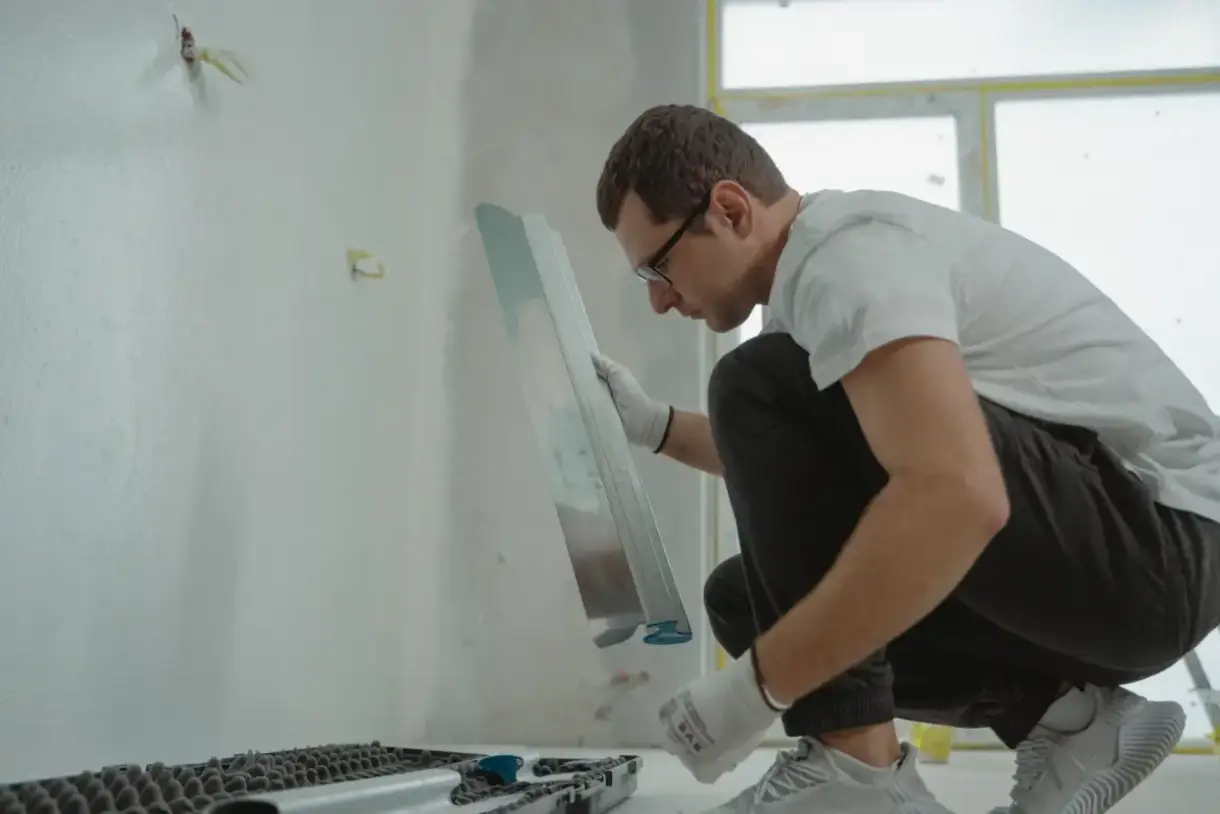
Sanding is taken to the finish level agreed at the start, checked under the room's actual lighting rather than a work light. A wall that passes under a bulb held close can still show every seam when the real fixtures go on and winter daylight crosses it at a low angle. Where new board meets existing surfaces, the texture is sampled from the original, reproduced on scrap, adjusted, and only then applied. Dust gets removed rather than moved around, and the surface is left genuinely ready for primer instead of nearly ready. Texture and profile matching do the heavy lifting here rather than a straight flat finish — a coved plaster edge on Miramar Drive and a sprayed ceiling near Sunset Park are both matching problems, just different ones.
Fix the Cause, Then the Ceiling
A phone number and a truck in the driveway don't make a company. Here's what's actually different about ours for a job in Allouez, WI.
The Cause Gets Named, Not Just the Damage
A stained ceiling in this climate usually has something above it still going on. You get told what is actually causing it, even when the honest answer is that another trade needs to go first.
One Relationship, Start to Final Coat
Your details don't get sold to whoever bids fastest. The same experienced drywall professional runs the job from the first walkthrough through the last pass with the sander.
Repairs Meant to Survive a Winter
Refilling the same screw pop every March isn't a repair, it's a routine. Fasteners get set back into solid framing and the surface refinished so the fix holds through the next heating season.
What Drywall Work Looks Like in Allouez, WI
Robinson Hill and the Plaster-to-Drywall Transition
The Robinson Hill Historic District, listed in 2021, covers a tree-lined neighborhood of middle-class homes built from 1910 to 1953 along South Jackson and South Van Buren Streets — a 1910 Dutch Colonial Revival, a 1921 American Foursquare, a 1935 Colonial Revival. That date range straddles the exact decades when drywall replaced plaster as the standard interior finish, which means two houses a block apart in the same district can need completely different work. Anywhere in this district, identifying the wall system is the first step rather than an assumption.
Miramar Drive and Tudor Revival Interiors
The Miramar Drive Residential Historic District, listed in 2018, is a neighborhood of 26 homes between Riverside Drive and Nelson Court, many of them Tudor Revival, including houses from 1920, 1927 and 1930. Interiors of that period and style tend to have plaster with decorative detail — arched openings, coved ceiling edges, plaster returns at windows — and a repair there is not just a flat patch. Reproducing a curved or coved profile in compound is slower and more skilled work than filling a hole in a flat wall, and an honest quote reflects that.
Sunset Circle and Postwar Ceilings
The Sunset Circle Residential Historic District, listed in 2024, covers homes built from 1940 to 1989 around Sunset Park, including a 1940 Colonial Revival, a 1956 Contemporary and a 1959 Ranch. Everything in that range is drywall-era construction, and ceilings from the 1950s and 60s in particular were usually sprayed. A sprayed ceiling from that period is the hardest thing in this trade to match — the original aggregate and equipment are no longer standard, so a match gets sampled from the existing ceiling and tested on scrap before it goes anywhere near the room.
Heritage Hill and Institutional Buildings
Heritage Hill State Historical Park is a 56-acre open-air museum in Allouez, and the Green Bay Correctional Institution — listed on the National Register as the Wisconsin State Reformatory, with its North Cell Hall started in 1898 and South in 1915 — sits along the east bank of the Fox River. Institutional buildings of that age are masonry and plaster at the core with decades of later interior work layered on, and any drywall job in one starts by finding out what is actually behind the existing surface rather than trusting a drawing.
Remodels in Occupied Houses
In a village with no new construction, nearly every residential job happens with a family living in the house. That changes the work more than the technique does. Containment and floor protection stop being courtesies, sanding gets planned around when people are home, and the sequence gets built around keeping one bathroom and one route through the house usable. A quote that does not account for that is a quote for a different job than the one you have.
Where This Comes Up Around Allouez, WI
Split from Bellevue in 1874
Allouez separated from the town of Bellevue in 1874 to become its own entity, which is why two villages that now feel very different sit directly beside each other. Bellevue kept the farmland and the room to grow; Allouez kept the riverfront and filled in early.
Bounded by Two Rivers
Two rivers and two municipalities box the village in on all four sides, which is the short explanation for why the housing here is old and why the work is repair rather than installation. The village also has no separate police department, contracting patrol through the Brown County Sheriff's Office — the kind of shared-service arrangement small, fully built-out municipalities tend toward.
When We’re Not the Right Call
- One small hole behind a door. A patch kit, a putty knife and a sanding sponge cost less than the trip out, and on a three-inch hole the result is honestly about the same.
- Walls where the lath behind the plaster has let go across a whole room. That is a plaster specialist's job rather than a drywall finisher's, and pretending otherwise wastes your money twice.
- A ceiling texture sprayed in the early 1970s, on a job where an invisible patch is the requirement. Sometimes the honest answer is skimming the whole ceiling flat instead of chasing a match that never quite disappears.
- Popcorn ceilings in a house built before the early 1980s, on a same-week timeline. Testing comes first and its result sets the schedule, not the calendar.
- Work you want priced over the phone. Framing condition, ceiling height and what the light does to a wall do not come through on a call, and a number given without seeing them is a number that changes later.
Frequently Asked Questions
- Do you serve Allouez, WI?
- Yes. Allouez is about 2.4 miles south of Green Bay in straight-line terms — closer to downtown than any other village in the metro — and it is fully inside the regular coverage area.
- Is my Allouez house plaster or drywall?
- It depends on the decade, and Allouez spans the transition. Houses from the 1910s and 1920s are almost certainly plaster over wood lath. Houses from the 1950s onward are board. The 1930s and 40s go either way. The reliable check is at an outlet or switch box, where the cut edge of the wall shows — plaster is noticeably thicker and harder, and there is wood lath behind it rather than paper facing.
- Can plaster be repaired, or does it all have to come out?
- Both are legitimate answers and the wall decides which. Where the plaster is sound and the lath still holds it, patching and skim-coating is the better and cheaper result. Where the lath has let go across a large area — usually visible as plaster that flexes or sounds hollow over a wide field — that section gets converted to board, with a skim coat carrying the joint so the two surfaces read as one. Converting a whole room out of habit when the lath is fine is money spent for nothing.
- Can a decorative plaster profile be reproduced?
- Usually, and it is slower work than a flat patch. Coved ceiling edges, arched openings and plaster returns at windows are common in the Tudor Revival and period houses here, and reproducing one means running the profile in compound rather than filling and sanding flat. It is worth asking for a quote that separates that work out, so you can see what the decorative portion actually costs.
- What does drywall and plaster work cost in Allouez?
- The range is wider here than in newer suburbs, because the jobs are less alike. A flat patch on a 1960s wall and a coved plaster repair in a 1927 house are not the same labor. Texture matching runs meaningfully above a plain smooth finish, and plaster work runs above drywall work. That is why the number comes after someone sees the wall rather than over the phone.
Learn More
- Gypsum Association GA-214 — the published definition of drywall finish levels 0 through 5
- USG Construction Handbook — manufacturer guidance on temperature and humidity requirements for joint treatment
- Wisconsin DSPS Uniform Dwelling Code — the state code governing one- and two-family dwelling construction
Need Drywall Work Done in Allouez, WI?
Tell us what’s going on and get an immediate on-site quote — no charge for the estimate, and no obligation to book it.
Get My Free Estimate